About me
Last updated: 2026-09-07
More about me
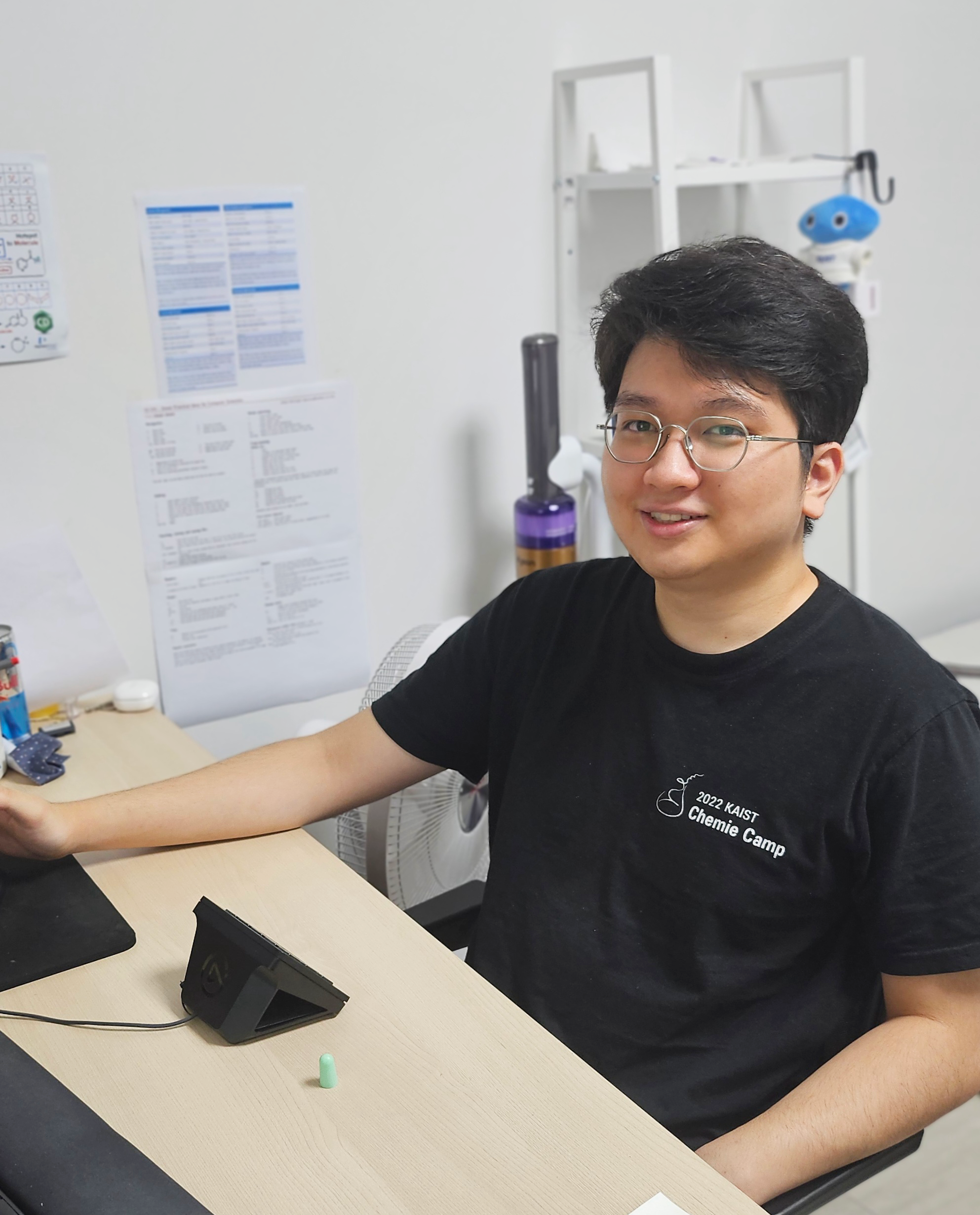
Shinyoung Park
moc.liamg 📧 liam.krap.gnuoynihs / View CV as PDF
Research interests
- Computational and AI/ML chemistry
- Their applications across various areas of chemistry and materials science
Education
Princeton University
Princeton, NJ, US
Ph.D. in Chemical Engineering
2026 – Present
Korea Advanced Institute of Science and Technology (KAIST)
Daejeon, Korea
B.S. in Chemistry
2020 – 2026
• GPA: 4.27/4.30 | Class Rank: 1/441
Research Experience
Intelligent Chemistry Lab – KAIST Department of Chemistry
Daejeon, Korea
Undergraduate researcher with Prof. Woo Youn Kim
2022 – 2025
-
Developed the AutoCG package for generating input reactant/product conformations for interpolation transition state (TS) search methods.
- Devised strategies to obtain low-energy TS structures with AutoCG on 32 benchmark reactions.
- Published an article in the Journal of Chemical Theory and Computation as co-first author.
-
Developed MetalloGen, an automated tool for generating 3D conformers of organometallic complexes with challenging polydentate and polyhapto ligands.
- Proposed ligand embedding/refinement strategies and benchmarked MetalloGen on 80 complexes.
- Published an article in the Journal of Chemical Information and Modeling as second author.
-
Extended capabilities of ACE-Reaction, a graph-theoretic method for exploring chemical reaction networks.
- Devised and implemented an atom mapping scheme for unbalanced chemical reaction equations using mixed-integer linear programming with SciPy.
- Developed a message-passing neural network with PyTorch Geometric to sample kinetically plausible elementary reactions.
- Built multi-level TS search workflows integrating semi-empirical and DFT methods to improve reaction network exploration efficiency.
Awards
KFAS Overseas PhD Scholarship
2026 – 2031
Korea Foundation for Advanced Studies
National Science & Engineering Scholarship
2023 – 2024
Ministry of Science and ICT, Korea
Dean's List
Spring 2020, Spring/Fall 2022, Spring/Fall 2023, Fall 2024
KAIST
Technical Skills
Programming and other Languages
Python, C/C++, MATLAB, LaTeX, Markdown
Libraries
NumPy, SciPy, Matplotlib, Pandas, scikit-learn, PyTorch, PyTorch Geometric
Developer Tools
Git, Bash, SSH, SLURM, Vim/Neovim, VS Code, JupyterLab, GitHub, GitHub Pages
Scientific Tools
Gaussian, ORCA, MOPAC, xTB, CREST, GROMACS, RDKit, Qiskit
Graphic Design and Visualization Tools
Photoshop, Illustrator, ChemDraw, Avogadro, PyMOL
Selected Coursework
Machine Learning Basics and Practices, Computational Chemistry,
Quantum Chemistry, Statistical Thermodynamics, Organometallic Chemistry
Quantum Chemistry, Statistical Thermodynamics, Organometallic Chemistry
Academic Service
KAIST Department of Chemistry Student Council
Daejeon, Korea
Head of the Internationalization Team
Aug 2023 – Feb 2024
Member of the Design Team and the Academic Affairs Team
Mar 2022 – Aug 2023
-
Founded the Internationalization Team to support international students and compiled
‘A Guide to the Department of Chemistry’, a comprehensive English-language resource featuring essential information, curated links, and practical guidance. - Supported international students by translating Korean announcements and documents into English and providing Korean-English interpretation at departmental events.
- Designed promotional materials, including pamphlets highlighting Department of Chemistry labs and their research for prospective undergraduate and graduate students.
- Coordinated the 2022 KAIST Chemie Camp, where high school students nationwide were invited to explore and experience cutting-edge chemistry research and education at KAIST.
Publications
†Denotes equal contribution
- Lee, K.; Park, S.; Park, M.; Kim, W. Y. MetalloGen: Automated 3D Conformer Generation for Diverse Coordination Complexes. J. Chem. Inf. Model. 2025, 65 (21), 11878–11891. DOI: 10.1021/acs.jcim.5c02074
- Lee, K.†; Lee, J.†; Park, S.†; Kim, W. Y. Facilitating Transition State Search with Minimal Conformational Sampling Using Reaction Graph. J. Chem. Theory Comput. 2025, 21 (5), 2487–2500. DOI: 10.1021/acs.jctc.4c01692